No heater before Anzac day: Canberra’s most popular social norm?
If you’ve spent at least one winter in Canberra (or many!), you will know the unofficial rule: don’t turn your heater on until Anzac Day.
But why?
Why do thousands of otherwise rational adults choose to shiver in their own living rooms, swaddled in Oodies and clutching hot water bottles, just to wait for an arbitrary date on the calendar?
As a behavioural scientist, I’m fascinated by the way people behave. Especially if it’s illogical. Let’s find out:
Cultural-historical context
Excuse the academic jargon. This concept of cultural-historical context comes from Cultural Historical Activity Theory, which argues that you cannot understand human behavior by looking at the person alone. Instead, you have to look at the "cultural tools" (like the rules of your society) and the "historical context" (the events of the past that shaped those rules). I looked at this theory as part of my PhD research as a method for making sense of complex systems.
So, to truly understand why we shiver through April, we need to look at the cultural-historical context of our city and its heating. The origins are surprisingly practical.
Back in the 1950s, thousands of newly arrived workers and public servants were housed in government-run hostels, relying entirely on log fires to survive the bitter local winters. However, bureaucratic frugality dictated a strict, unyielding schedule of rationing fire wood. Hostel caretakers operated under this rationing system and flatly refused to distribute firewood to residents until late April, right around Anzac Day. This means uou couldn't turn on a heater; you had to wait for the wood.
There's a good meteorological case for the April timing. An analysis of historical temperature trends reveals the tradition is also based on meteorological reality. Daily maximum temperatures typically drop by an average of 2 degrees in the week immediately following April 25.
So, what began as a practical cost-saving measure has become normalised as a collective behaviour.
Being part of the in-group
Humans are deeply social creatures and we navigate our daily lives using heuristics (mental shortcuts). One of the most influential of these shortcuts is looking and copying what everyone else is doing.
In behavioural science, we differentiate between two types of norms. Descriptive norms are what people actually do, while injunctive norms are what behaviours are socially approved or disapproved of.
The Anzac Day rule is an injunctive norm. If you confess over the office watercooler on April 14th that you caved and turned the heater on, you won't be arrested. But you will be met with gentle mockery, raised eyebrows, and the subtle implication that you are gave in early.
To avoid this social friction and remain in the good graces of the in-group, we conform. We choose the physical discomfort of the cold over the psychological discomfort of social judgment.
Group identity
This concept from from Social Identity Theory, which states that a significant portion of our self-concept is derived from the social groups to which we belong.
We don't just see ourselves only as individuals, rather we categorise ourselves as members of a "tribe". This could be a profession, a nation, or, in this case, the residents of a cold capital city. Once we identify with a group, we naturally engage in "in-group favouritism," where we uphold the group’s values and behaviours to reinforce our sense of belonging.
The "no heater until Anzac Day" rule acts as a psychological mechanism for this: by adhering to the collective sacrifice of the group, individuals solidify their identity as a "true Canberran."
This creates a sharp psychological boundary between the in-group (those who endure the cold and share the identity) and the out-group (those who "cave" and turn the heater on early). Ultimately, the primary drive is the preservation of that social identity and the social capital that comes with being a committed member of the Ken Behrens tribe.
The take away
When we want to design behaviour change interventions in the workplace or in public policy, we often look for complex, expensive levers. We try to use financial incentives, deep educational campaigns, or stringent rules. But the Canberra Anzac Day rule reminds us that sometimes, the strongest drivers of human behaviour can be intangible.
If you want to make a behaviour stick, you don't necessarily need to pay people. You just need to tap into their desire to belong to the tribe, give them a clear, hard anchor to aim for, and perhaps you will create the next decade-strong norm.
Now, if you'll excuse me, I need to go find another pair of woollen socks. It's not the 25th yet.
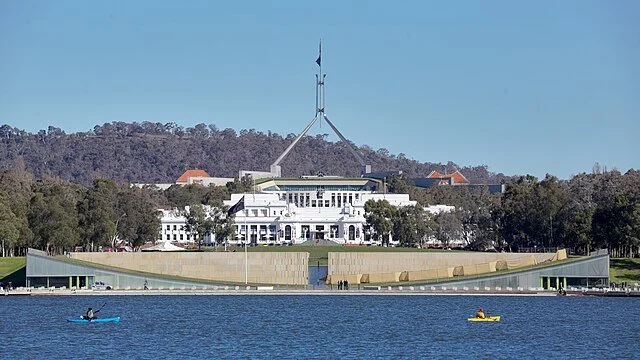
Image reference
Old and new Parliament Houses; Canberra Australia [Photograph]. (2007). Wikimedia Commons. https://commons.wikimedia.org/wiki/File:Old_and_new_Parliament_Houses;_Canberra_Australia.jpg. Licensed under CC BY 3.0.